
Johnson County Clerk of Superior Court
Patricia Glover is listed as Johnson County Clerk of Superior Court. The official county page gives the courthouse address, phone, fax, and mailing address. The GSCCCA clerk profile adds that Patricia Glover was elected in 2000, identifies county code 83, lists Chief Deputy Debra Hall, and states that the clerk manages Superior, Juvenile, and Magistrate courts. GSCCCA also lists the clerk as Child Support Receiver and Custodian of Law Library.
That office should not be confused with the administrative County Clerk in county government. Johnson County's staff directory identifies Cassie Walters as County Clerk in county administration, but court case files, felony criminal dockets, divorce files, title-to-land matters, equity cases, and many court-copy requests point to the Clerk of Superior Court. County commission minutes, general county administration records, and some open-records routing may start at county administration instead.
Johnson County Clerk of Superior Court
Clerk: Patricia Glover
2557 East Elm Street
Wrightsville, GA 31096
Mail: Johnson County, PO Box 321, Wrightsville, GA 31096
478-864-3484
Fax: 478-864-1343
Hours: 9:00 a.m.-5:00 p.m. per GSCCCA
The official county clerk page appears in the manifest from Johnson County's Clerk of Superior Court source.
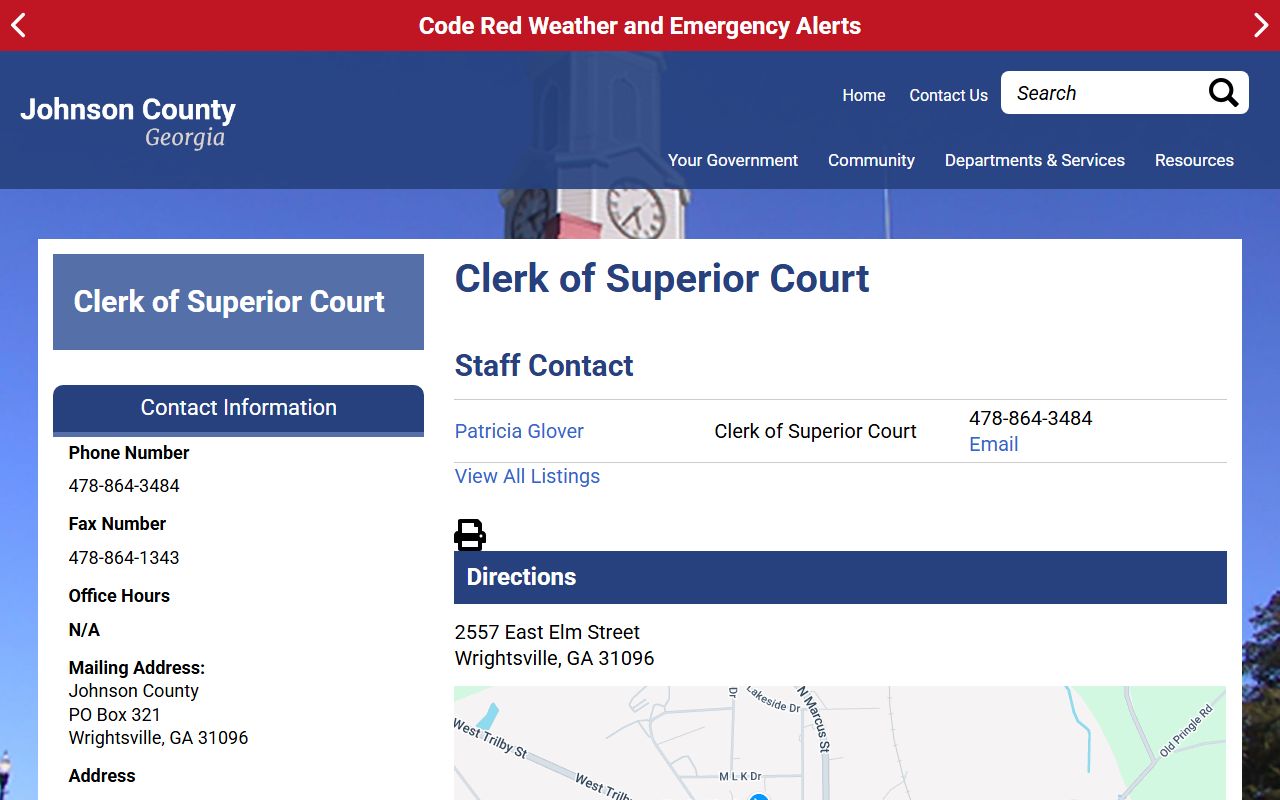
That page anchors the local contact route when an online portal does not provide the copy, certification, or case file a requester needs.
Johnson County Clerk Record Scope
The Clerk of Superior Court is the filing office for Johnson County Superior Court records. Superior Court in Georgia handles felony criminal cases, divorce, equity, title-to-land cases, major civil matters, and review or correction from lower courts. GSCCCA also lists Johnson County Juvenile and Magistrate courts under the clerk's managed courts, but public access can differ sharply by case type.
- Superior Court civil filings, orders, judgments, liens, and equity records
- Felony criminal filings, accusations, indictments, pleas, dispositions, and sentences
- Divorce files and certified divorce decree requests
- Juvenile records where access is restricted or carefully routed
- Magistrate civil records routed to the clerk phone line
- Child-support receiver and law-library functions listed by GSCCCA
Probate records, marriage license functions, and most estate matters should start with Probate Court. The Johnson Probate page also gives a useful split for Magistrate questions: criminal Magistrate matters call 478-864-3316, and civil Magistrate matters call 478-864-3484.
Johnson County Clerk Online Access
Johnson County does not publish a county-branded full case-search portal on the county site. The official online route for Superior Court records starts with Georgia Courts eAccess, which lists Johnson Superior and routes access to PeachCourt. PeachCourt advertises civil and criminal eFiling, court documents, registration, login, and support through 844-GA-EFILE, but public case-search fields were not visible before login in the research.
Certified electronic documents may also involve GSCCCA eCertification. That portal requires a GSCCCA universal account for requests and offers a public authentication-code lookup for a certified document that has already been issued. The GSCCCA Johnson County clerk profile is not a case database, but it is authoritative for clerk identity, managed courts, hours, legal organ, and office details.
| Channel | Use | Important limit |
|---|---|---|
| Georgia Courts eAccess | Find Johnson Superior provider route | Redirects to provider and may require account access. |
| PeachCourt | Superior Court eFiling and document access | Search fields are account-gated before login. |
| GSCCCA eCertification | Request or authenticate certified digital documents | Requests require account registration. |
| Clerk counter or mail | Older records, certified copies, sealed-record questions | Call first for fees and availability. |
The manifest includes GSCCCA's clerk source from the Johnson County clerk profile.
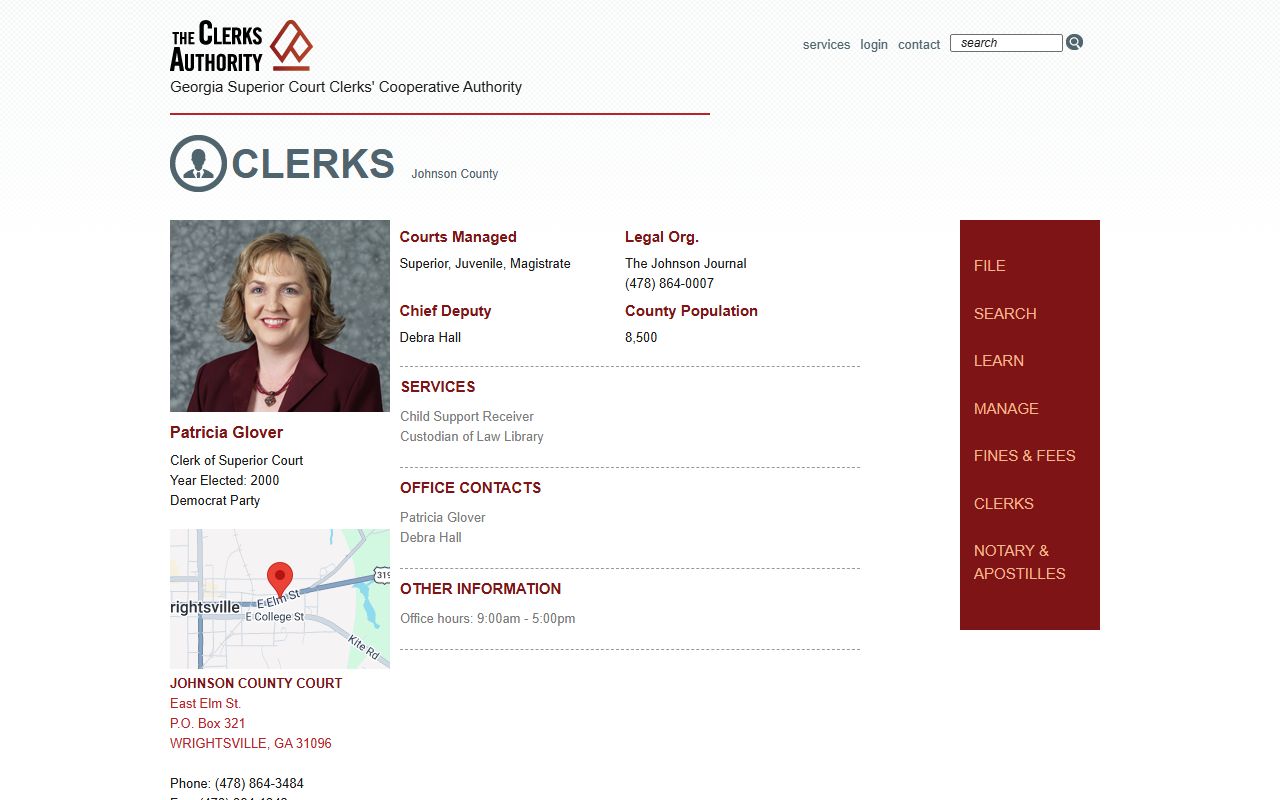
That profile is especially useful because it confirms managed courts and hours where the county page leaves some fields sparse.
Request Johnson County Certified Copies
A certified copy is a clerk-issued copy that carries official certification. It is commonly needed for divorce decrees, judgments, orders, liens, case dispositions, or filings that must be accepted by another agency, court, employer, lender, school, or legal process. A plain online view is not the same thing as a certified copy.
- Identify the court and case type. Superior Court files should go to the Clerk of Superior Court; Probate Court files should go to Probate Court.
- Gather the case number if known, full party names, filing year, document title, and whether a plain, certified, or exemplified copy is needed.
- Check PeachCourt or Georgia eAccess if the record may be available online, then call the clerk when certification, older files, or sealed-record questions are involved.
- Confirm the fee, payment method, mailing method, and pickup options before sending a written request or money.
- For electronic certified records, check GSCCCA eCertification and use the authentication lookup only for documents that already have an issued code.
Note: The research did not locate a Johnson County clerk copy-fee schedule, so the clerk should confirm current charges before payment.
Johnson County Request Fields
Johnson County has an Open Records Request PDF linked through the 911 Call Center page. For filed court records, the cleanest path usually starts with the Clerk of Superior Court rather than a general county open-records form. Still, the county form is useful when a written request is needed or when a county agency record, such as a 911 record, is involved.
| Field or detail | Required | Notes |
|---|---|---|
| Requester name and contact | Yes | Needed so the office can respond, price, or clarify the request. |
| Record requested | Yes | Use case number, date, party names, location, call number, or document title if known. |
| Delivery or contact method | Unclear in extracted PDF | Confirm whether pickup, mail, fax, or email is allowed for the record type. |
| Copy type | Yes for court copies | State whether plain, certified, exemplified, or electronic certification is needed. |
| Agency routing | Important | 911 records before March 18, 2024 route to the prior agency, not the new call center. |
The Johnson County 911 records channel shown in the manifest comes from the official 911 Call Center page.
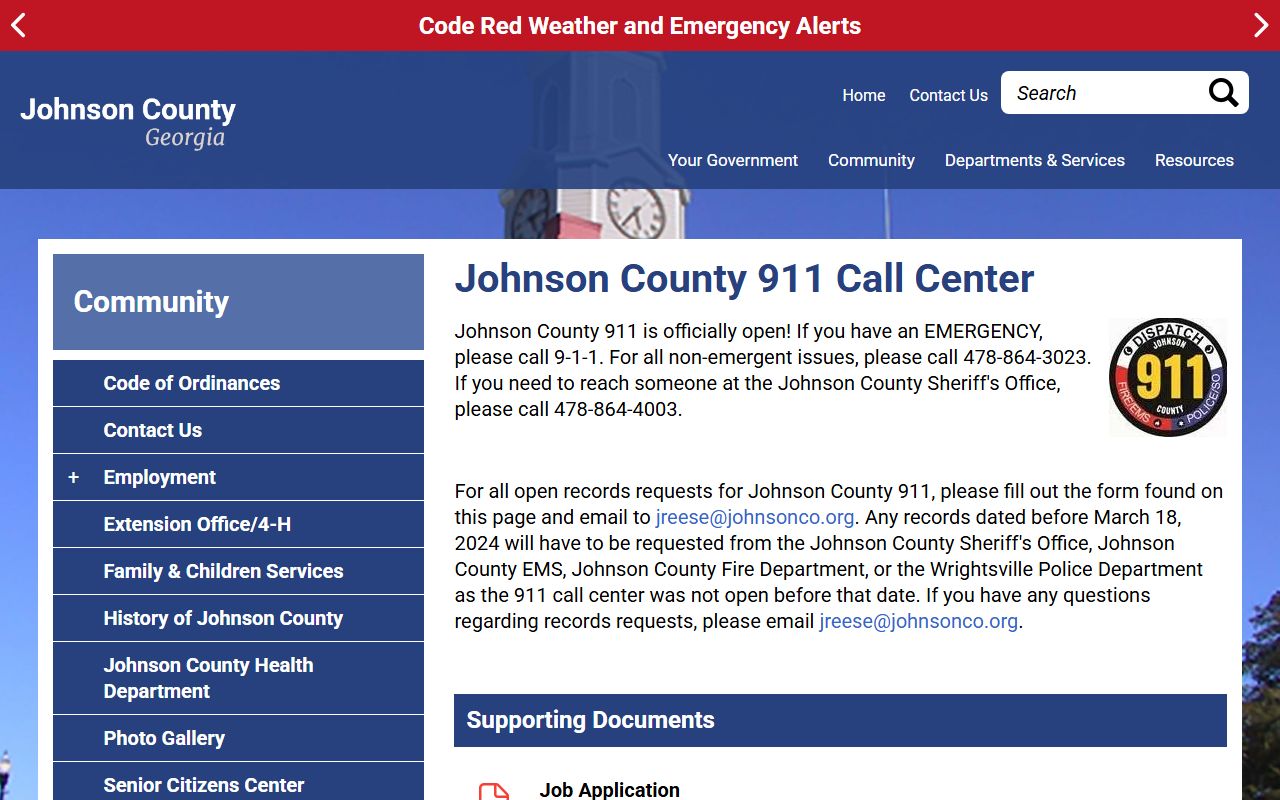
That page is not the same as a Superior Court case search, but it documents the county's written records-request process and the 911 date split.
Johnson County Clerk Fees
Official Johnson County sources reviewed for this build did not publish a detailed clerk fee schedule for plain copies, certified copies, exemplified copies, eCertification, or court searches. Georgia law allows lawful search, retrieval, copying, and redaction costs for open-records requests, but the amount depends on the request and the office processing it.
| Item | Amount or rule found |
|---|---|
| Plain court copies | Fee not located in official Johnson County sources. |
| Certified court copies | Fee not located; ask Clerk of Superior Court. |
| Exemplified copies | Fee not located; ask Clerk of Superior Court. |
| eCertification request | Portal requires account; public landing fee not visible in research. |
| Open Records Act county request | Costs may include lawful search, copy, retrieval, and redaction charges. |
A fee gap should be stated plainly rather than filled with statewide guesses. Certified-copy rules can change, and a court may quote the total only after it knows the case, document, copy count, and delivery method.
Johnson County Clerk Access Limits
Most adult Superior Court records are public unless sealed, restricted, or redacted, but the clerk must protect information that Georgia law and court rules keep out of public view. Juvenile records, adoption records, protected identifiers, sealed filings, some victim information, financial account numbers, and restricted criminal-history material may be unavailable to the general public.
For criminal record restriction, Georgia materials point to O.C.G.A. 35-3-37. For court-file access limits, Uniform Superior Court Rule 21 is the key sealing and limitation rule. The clerk can provide records and file copies, but the clerk cannot give legal advice about whether a record should be sealed, restricted, expunged, or corrected.